Quantum Computing Breakthrough: Germanium-Based Qubits
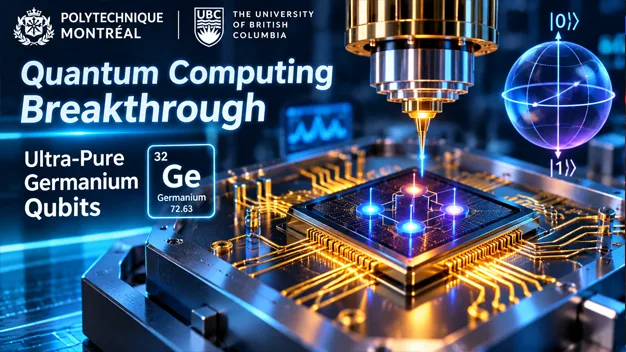
Researchers at Polytechnique Montréal and UBC have developed ultra-pure germanium semiconductor structures, paving the way for more stable and scalable quantum computers.
Quantum Computing Breakthrough: Researchers Develop More Stable Germanium-Based Quantum Processors
November 22, 2026 — Technology / Quantum Computing
Researchers from Polytechnique Montréal and the University of British Columbia (UBC) have achieved a significant breakthrough in the development of next-generation quantum computers. Their discovery involves creating germanium-based semiconductor structures with precisely controlled isotopic compositions, dramatically reducing magnetic interference that can destabilize quantum bits, or qubits.
Published in the scientific journal Advanced Science, the research could pave the way for more reliable quantum processors and eventually support the large-scale manufacturing of quantum computing chips.
The Biggest Challenge in Quantum Computing: Keeping Qubits Stable
Unlike traditional computers, which process information using binary bits representing either 0 or 1, quantum computers rely on qubits.
Thanks to quantum mechanical phenomena such as superposition and entanglement, qubits offer new ways to perform calculations that could eventually solve certain complex problems beyond the practical capabilities of conventional computers.
However, one major obstacle continues to limit quantum computing development: the extreme sensitivity of quantum information.
Qubits are highly vulnerable to environmental disturbances. Even tiny magnetic, electrical, or thermal fluctuations can alter their quantum states and introduce computational errors.
To build powerful and reliable quantum computers, scientists must develop materials capable of preserving quantum information long enough to perform accurate calculations.
Why Researchers Are Turning to Germanium
Scientists worldwide are exploring several approaches to developing the quantum processors of the future.
Companies such as IBM and Google have focused on superconducting circuits, while other research groups are investigating trapped ions, quantum defects in diamonds, and semiconductor-based technologies.
At Polytechnique Montréal, a research team led by Professor Oussama Moutanabbir is pursuing the semiconductor approach.
Their work focuses on germanium, a chemical element with electronic properties similar to silicon.
Germanium offers several important advantages.
It allows precise control over electrical charge carriers and can potentially be integrated into manufacturing processes compatible with today's semiconductor industry.
The long-term objective is to leverage existing chip manufacturing technologies to produce quantum processors containing thousands or even millions of qubits.
This industrial compatibility could become a major advantage when transitioning from experimental prototypes to large-scale quantum computing systems.
Atomic Interference: A Major Obstacle to Quantum Stability
Despite its promising properties, germanium presents a significant challenge for quantum computing applications.
Certain naturally occurring isotopes found in semiconductor crystals possess nuclear spin, causing them to behave like microscopic magnets.
Two particularly problematic isotopes are silicon-29 and germanium-73.
These isotopes can generate magnetic fluctuations that interfere with quantum states, potentially reducing the time during which qubits can reliably store information.
To overcome this limitation, researchers developed a strategy to manufacture semiconductor crystals with dramatically reduced concentrations of these isotopes.
Their approach favors isotopes without nuclear magnetic spin, particularly silicon-28 and germanium-70.
By carefully controlling the isotopic composition of the materials, scientists can eliminate a major source of magnetic noise.
Manufacturing Semiconductor Crystals with Atomic Precision
To achieve this level of control, the Polytechnique Montréal research team established specialized infrastructure for growing semiconductor crystals with precisely engineered isotopic compositions.
The researchers use a manufacturing technique known as epitaxial growth.
This process allows extremely thin crystalline layers to be deposited onto a substrate while maintaining precise control over their atomic structure and composition.
The resulting materials are then examined using advanced instruments capable of analyzing their organization at the atomic scale.
These measurements help researchers verify crystal quality and confirm the reduction of isotopes responsible for unwanted magnetic interference.
The breakthrough is not simply about using germanium. It is about engineering its isotopic composition to create a much more stable environment for quantum information.
This level of material control represents an important step toward improving semiconductor-based quantum devices.
A Scientific Collaboration Between Montréal and Vancouver
After producing the new semiconductor materials, the Polytechnique Montréal team needed to verify their electronic properties.
To accomplish this, they collaborated with Professor Joseph Salfi's research group at the Stewart Blusson Quantum Matter Institute at the University of British Columbia.
The UBC researchers investigated how the germanium structures behaved when subjected to different electrical voltages.
Their experiments demonstrated that electrical charges within the material could be precisely controlled.
This ability is essential for developing semiconductor-based qubits, as quantum information must be manipulated through carefully controlled physical interactions.
The results confirmed the potential of these engineered germanium structures for future quantum processor architectures.
Could Germanium Enable Quantum Computers with Millions of Qubits?
One of the greatest challenges in quantum computing is increasing the number of available qubits while maintaining their reliability.
Today's quantum processors have already demonstrated important experimental capabilities, but developing machines capable of performing complex, fault-tolerant calculations will require substantial additional progress.
Semiconductor-based quantum computing offers an attractive path because it could benefit from decades of industrial expertise in electronic component miniaturization.
Researchers hope that future manufacturing techniques could eventually support processors containing thousands or potentially millions of physical qubits.
However, eliminating magnetic noise is only one part of the challenge.
Scientists must also improve quantum gate fidelity, qubit readout, interconnections between quantum components, and error-correction technologies.
The latest discovery therefore represents a significant scientific milestone rather than the immediate arrival of commercially viable, large-scale quantum computers.
Potential Applications Across Multiple Industries
If quantum computing technologies reach sufficient maturity, they could transform several scientific and industrial fields.
In chemistry, quantum computers could enable more accurate simulations of complex molecules, helping researchers understand chemical reactions and discover new materials.
In pharmaceutical research, they could contribute to studying molecular interactions that are extremely difficult to model using conventional computing systems.
Quantum computing may also provide new approaches to certain optimization problems and improve scientists' understanding of complex physical phenomena.
Cryptography is another important area of concern.
Large-scale, fault-tolerant quantum computers could eventually challenge some of the encryption algorithms currently used to secure digital communications.
However, these possibilities depend on overcoming significant technical barriers and building quantum machines with sufficient reliability and computational capacity.
A Major Step Toward Industrial Quantum Computing
The collaboration between Polytechnique Montréal and the University of British Columbia demonstrates that a major source of instability in semiconductor materials can be significantly reduced through advanced isotopic engineering.
By combining highly purified germanium with manufacturing techniques compatible with the semiconductor industry, researchers have opened a promising path toward more reliable quantum computing architectures.
The discovery does not mean that quantum computers containing millions of qubits are just around the corner.
Nevertheless, it shows that one of the fundamental scientific obstacles can be addressed through improved control of materials at the atomic level.
The future of quantum computing may depend as much on breakthroughs in semiconductor materials as on advances in quantum algorithms, processor architectures, and error-correction systems.
As research continues, germanium-based quantum technologies could play an increasingly important role in the development of practical, scalable quantum computers.
Source: Polytechnique Montréal — Quantum Computing Breakthrough: Collaboration Between Polytechnique Montréal and UBC, originally published April 10, 2026.
https://www.polymtl.ca/carrefour-actualite/
Scientific publication: Advanced Science.
This article has been rewritten and adapted from research information published by Polytechnique Montréal.
Keywords: Quantum Computing, Quantum Computers, Germanium, Qubits, Polytechnique Montréal, University of British Columbia, UBC, Semiconductors, Quantum Processors, Quantum Technology, Scientific Research, Advanced Science.
Comments (0)
No comment yet. Be the first!