Keystone Data Breach Sparks Phishing Warnings Across the Dogecoin Community
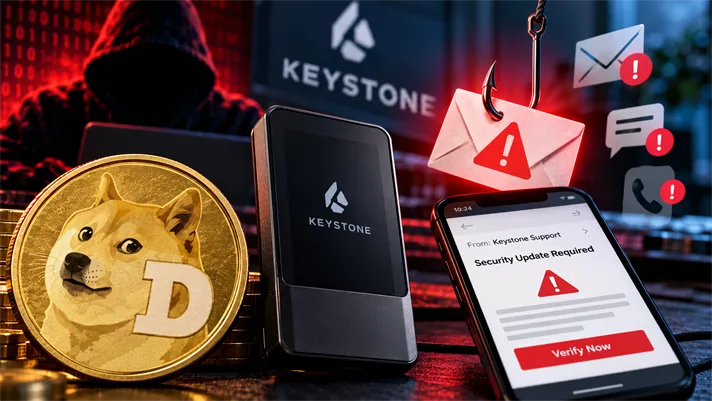
Keystone confirms a customer data breach, raising phishing concerns among Dogecoin and crypto users. Learn what was exposed and how to stay safe.
Cryptocurrency Security Alert: Keystone Data Breach Raises Concerns Over Targeted Scams
A new cybersecurity incident has shaken the cryptocurrency industry. Hardware wallet manufacturer Keystone has acknowledged a data breach involving the personal information of some of its customers. While digital assets do not appear to be directly at risk, concerns are growing over potential scams, phishing attacks, and identity theft.
When Personal Information Becomes a Weapon for Scammers
Hardware wallets are widely considered one of the safest ways to store cryptocurrencies. However, even these security devices cannot protect users against every possible threat.
The recent security incident reported by Keystone serves as another reminder of this reality.
Information belonging to certain customers was exposed following unauthorized access to the company's systems. This situation is particularly concerning because the compromised data could allow malicious actors to identify individuals who may own digital assets.
The threat therefore extends beyond computer systems and directly affects users' personal privacy and security.
Dogecoin Community Member Sounds the Alarm
On social media platform X, Mishaboar, a well-known figure within the Dogecoin community, urged hardware wallet owners to exercise caution.
His main concern involves the potential misuse of the stolen information.
Cybercriminals could attempt to contact affected customers through various channels, including emails, text messages, phone calls, and even physical letters delivered to their homes.
These fraudulent approaches may appear particularly convincing when scammers already possess their targets' names, contact details, and purchase information.
Similar incidents have previously affected customers of other major hardware wallet manufacturers, including Ledger and Trezor.
Personal Information Exposed, but Wallet Private Keys Remain Secure
In its official statement, Keystone clarified which categories of customer information were affected by the security incident.
The exposed data reportedly includes customer names, contact information, shipping addresses, and certain order-related details.
However, the manufacturer maintains that the most sensitive information required to access cryptocurrency holdings was not compromised.
Private keys, wallet recovery phrases, passwords, and banking information were reportedly not included in the exposed data.
Although this clarification offers some reassurance to customers, it does not eliminate the possibility of fraud.
Fake Refunds and Fraudulent Security Procedures
One of the most significant threats involves fraudulent messages impersonating the hardware wallet manufacturer.
For example, a customer might receive a notification claiming that a security vulnerability requires an immediate wallet replacement.
Another user could be encouraged to request a refund or verify personal information to receive technical assistance.
Behind these seemingly legitimate requests could be attempts to steal confidential information.
The ultimate objective of such scams may be to obtain a wallet's recovery phrase, also known as a seed phrase, which allows access to cryptocurrency holdings to be restored.
Once criminals obtain this information, they may be able to gain control of the associated digital assets.
Keystone Takes Steps to Contain the Incident
Keystone says it has implemented several measures following the discovery of the breach.
According to the company, unauthorized access has been blocked and the vulnerability responsible for the incident has been addressed. An investigation has also been launched to better understand how the breach occurred.
Meanwhile, Keystone has begun notifying affected customers about the situation.
The company strongly advises users to verify the authenticity of any communications they receive and never disclose information that could be used to restore access to their cryptocurrency wallets.
A Threat That Extends Far Beyond Dogecoin
Although the warning has gained considerable attention within the Dogecoin community, the potential consequences are not limited to DOGE holders.
Any customer affected by the breach could face similar risks, whether they own Bitcoin, Ethereum, Dogecoin, or other digital assets.
The incident highlights an often-overlooked weakness in the cryptocurrency ecosystem: the protection of personal and commercial customer information.
A hardware wallet may keep private keys securely offline while its owner remains vulnerable to identity-based attacks and social engineering.
This distinction demonstrates that protecting digital assets requires more than simply using secure storage technology.
Staying Vigilant Remains the Best Defense
Cybersecurity experts consistently recommend never sharing private keys or wallet recovery phrases under any circumstances.
Any unexpected request involving a cryptocurrency wallet should be treated with caution, even when the message appears to originate from a trusted company.
Users should contact manufacturers directly through verified official channels rather than responding to suspicious messages or clicking unfamiliar links.
The Keystone incident ultimately reinforces an essential principle: protecting cryptocurrencies also means protecting your digital identity.
Comments (0)
No comment yet. Be the first!